
Nothing Is True—Everything Is Managed

How the ideologies we thought we defeated dissolved into the soft power systems that now shape reality itself
There is a peculiar conceit at the heart of modern life: that we are emancipated. Freed from superstition, liberated from hierarchy, unshackled from the metaphysical burdens that weighed upon earlier ages. We flatter ourselves that we inhabit a world of choice—of self-creation, of self-definition, of values authored rather than inherited.
And yet, the atmosphere feels curiously thin. Our freedoms expand even as our sense of reality contracts. We are surrounded not by truth, but by competing assertions of it—each provisional, each contingent, each awaiting displacement by something more forceful, more fashionable, or simply more convenient.
To understand how we arrived here, one must pass not only through Nietzsche, but through Heidegger’s unsettling interpretation of him. For what appears, at first glance, as a philosophy of rebellion is revealed instead as something far more terminal: the completion of a long and fateful trajectory in Western thought.
Nietzsche, we are told, overturned Platonism. He inverted its values, declared the death of God, and exposed the illusions that underpinned morality. But Heidegger’s claim is more disquieting. Nietzsche does not escape metaphysics—he consummates it. The will to power does not shatter the tradition; it perfects it.
For what is the will to power, if not the final answer to the question of Being? No longer grounded in eternal forms, nor divine order, nor rational structure, Being is reduced to a single, all-encompassing principle: the ceaseless assertion of force. Everything that is, is insofar as it strives, expands, dominates, interprets. Truth dissolves into perspective; reality into contest.
At the center of this stands Nietzsche’s great preoccupation: the question of values. If God is dead, then values are neither given nor discovered—they are created. But creation here does not mean contemplation or revelation. It means imposition. Values become expressions of power, instruments of ordering the world in accordance with a particular will.
This is not the overcoming of nihilism, as Nietzsche believed. It is its fulfillment. For nihilism does not consist merely in the destruction of values, but in their reduction to something arbitrary—something contingent upon the strength of those who assert them. In such a world, nothing is true in itself; everything is a function of valuation.
The implications are difficult to overstate. Once Being is subordinated to will, the world becomes available in a new and terrifying way. It is no longer something to be encountered, but something to be organized. Nature becomes resource. Humanity becomes material. Culture becomes apparatus.
Here, Heidegger’s insight cuts deepest. The technological age is not an accident of progress; it is the destiny of Nietzsche’s metaphysics. If reality is will to power, then technology is its most perfect expression: the ordering, optimization, and control of all things. The world is no longer a cosmos, but a standing reserve—awaiting use, calculation, deployment.
One need not look far to see how this logic extends into politics. The totalitarian ideologies of the twentieth century—whether draped in the language of race or class—were not aberrations from this trajectory, but its most explicit manifestations. Each sought to impose a total interpretation upon reality. Each reduced truth to ideology, and ideology to power. Each treated human beings not as ends, but as instruments in a vast project of reordering.
But these ideologies were not static. They were protean—capable of mutation, adaptation, and survival beyond their apparent defeat. Their more grotesque expressions may have been discredited, yet their underlying impulse did not disappear. It diffused, softened, and rearticulated itself in forms more compatible with the moral sensibilities of the post-war world.
What remains is the same structural logic: the primacy of constructed values, the centrality of interpretation, and the drive to reorganize society in accordance with these valuations. In place of overt coercion, we find managerial systems. In place of explicit domination, soft power. In place of rigid doctrine, a fluid but no less insistent moral framework—one that claims universality while grounding itself in historically contingent assumptions.
Contemporary progressive, liberal-globalist politics often presents itself as the antithesis of those earlier regimes: pluralistic rather than total, humane rather than brutal, emancipatory rather than oppressive. And in many respects, it is. But at a deeper level, it operates within the same metaphysical horizon. Values are not discovered but asserted; truth is not uncovered but constructed; reality is something to be administered.
The difference is not one of essence, but of method. Where twentieth-century ideologies imposed unity through force, contemporary systems achieve coherence through networks—institutions, norms, and incentives that shape perception and delimit what can be said, thought, and ultimately believed. The language is one of inclusion, equity, and progress, yet it functions to order the world according to a particular vision, one that tolerates little genuine opposition.
Thus, the will to power becomes less visible, but no less pervasive. It no longer announces itself in grand historical projects, but operates through the quiet standardization of thought and the subtle enforcement of values. The result is not the end of ideology, but its internalization.
And yet, there was a time when the question of Being was asked differently.
Before Plato, before the division of reality into appearance and idea, there were the Presocratics. For them, truth was not something constructed or imposed, but something disclosed. Being was not an object of mastery, but a mystery to be encountered. The Greek word for truth—aletheia—meant unconcealment: a bringing-forth into presence.
In this first beginning, man did not stand over against the world as its legislator. He stood within it, attentive to its emergence. There was no question of “values” in the modern sense, because there was no separation between what is and what ought to be. The world itself carried a kind of order, one that could be glimpsed, but never fully possessed.
It is here that a comparison with Leibniz becomes unexpectedly illuminating. For Leibniz, perception is not passive reception, but an active striving—a movement toward clarity, toward fullness of being. Appetite, in his terms, is the drive that propels this striving, an inner dynamism that pushes each entity toward its own unfolding.
In Nietzsche, this structure is radicalized. Striving becomes will to power; perception becomes interpretation; unfolding becomes domination. What was once a movement toward participation in Being becomes a movement toward its appropriation. The subtlety of Leibniz’s metaphysical vision is flattened into a universal struggle.
Thus, the arc becomes visible. From the Presocratic openness to Being, through the Platonic elevation of the ideal, to the modern reduction of truth to representation, and finally to Nietzsche’s identification of Being with will—each step tightens the grip of metaphysics, even as it claims to liberate.
With Nietzsche, the loop closes. Platonism is not destroyed, but inverted. The “true world” is abolished, only for the “apparent world” to become all that remains—and even that is no longer stable, but subject to endless reinterpretation.
What follows is not clarity, but confusion. Not liberation, but disorientation.
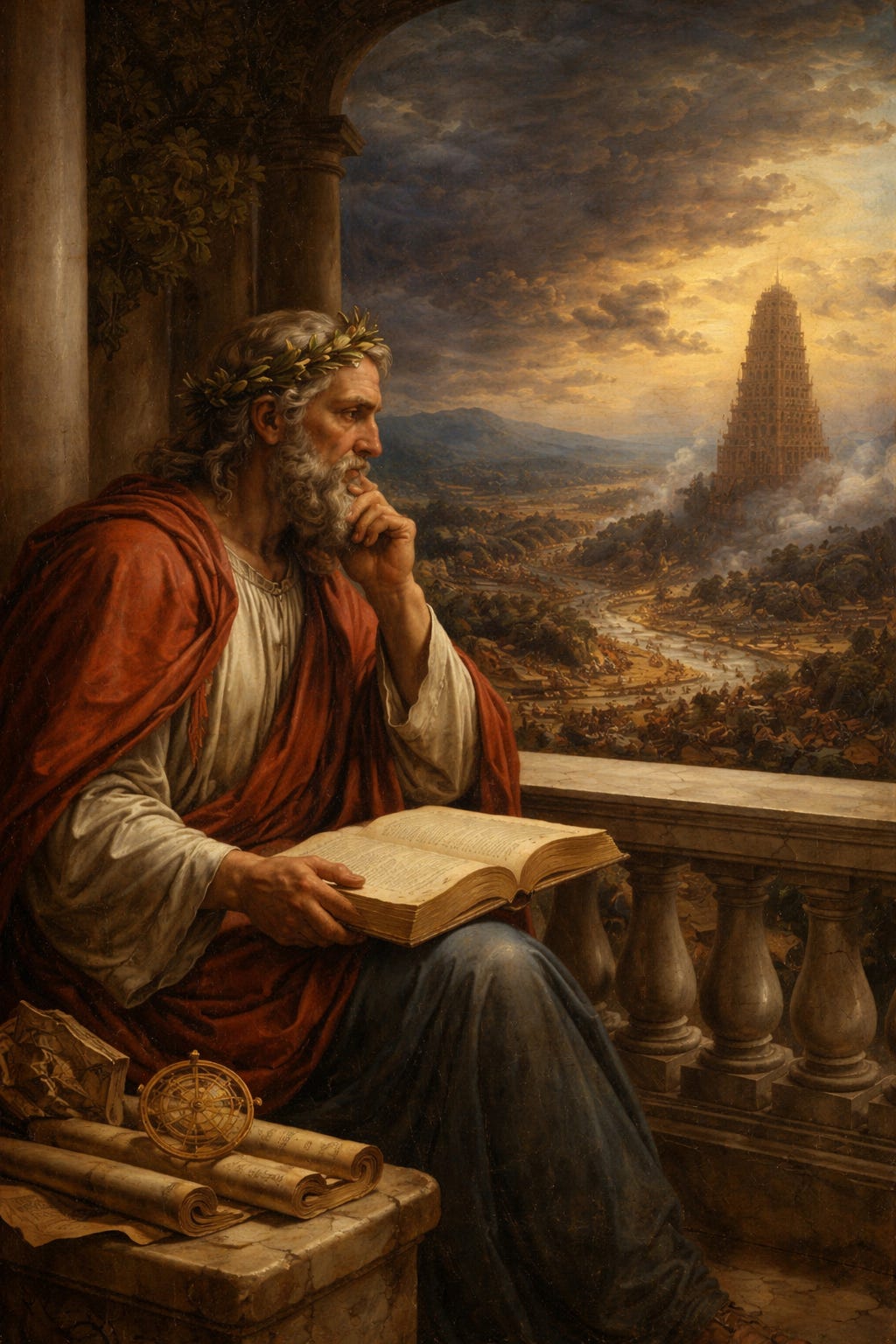
We find ourselves, now, in something like a new Tower of Babel—not of languages, but of values. Competing worldviews rise and collapse with dizzying speed. Moral frameworks are constructed and deconstructed in real time. Everything is ordered and reordered, optimized and re-optimized, in an endless cycle of assertion and revision.
There is power everywhere, and meaning nowhere.
If there is a way forward, it cannot consist in yet another revaluation of values. That path has been exhausted. Nor can it lie in a nostalgic return to earlier metaphysical systems, whose foundations have already crumbled.
It must instead involve a more radical gesture: a return, not to the answers of the first beginning, but to its conditions. To the openness that allowed Being to appear as something other than a resource. To the humility that recognized truth as something disclosed, rather than imposed.
Heidegger names this possibility Ereignis—a new beginning, not in the sense of a chronological restart, but as a re-appropriation of our relation to Being itself.
Greek philosophy marked the first beginning. Nietzsche, in closing the metaphysical loop, marks its end.
What lies between is the long history of Western thought. What lies ahead is less certain.
But if we are to emerge from the present darkness—from this ceaseless ordering and reordering of a world that no longer speaks—we may need to recover something that has long been forgotten: not the power to create values, but the capacity to listen for what is.
The distinction between method and essence is doing a lot of work here — and rightly so. What you’re describing is ideology that has become so thoroughly ambient it no longer needs enforcement because it’s been fully internalized. Foucault called it discipline. You’re locating the metaphysical root Foucault wouldn’t touch. That’s the more honest diagnosis, even if it’s the less comfortable one.
Thank you for writing this! More please 💙