
When Ideals Replace Reality
Aristotle and the Return of Political Abstraction in Modern Science and Society

Two and a half thousand years ago, Aristotle identified a problem that remains at the heart of modern politics.
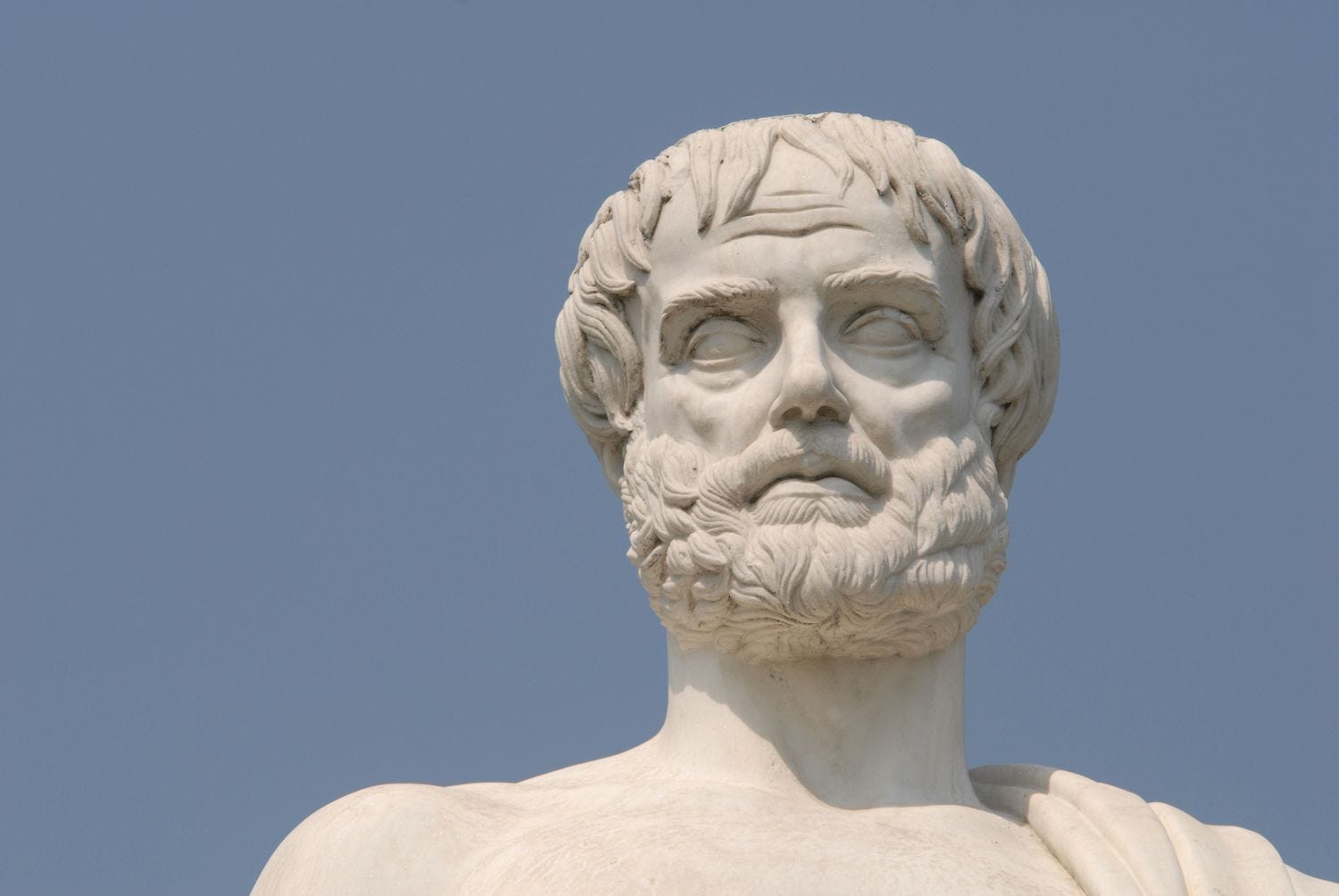
In Book I of The Nicomachean Ethics, he turns his attention to one of the most influential ideas in Western thought: Plato’s concept of “The Good.”
For Plato, all good things derive their goodness from participation in a single, universal, transcendent Good. Justice is good because it partakes in the Good. Wisdom is good because it partakes in the Good. Courage, beauty and virtue are all good because they reflect this higher reality.
It is a magnificent idea. It is also, Aristotle suggests, profoundly dangerous.
Aristotle’s criticism is deceptively simple.
When we look at the world, we discover that “good” is spoken of in many ways. A good doctor is not the same thing as a good soldier. A good constitution is not the same thing as a good harvest. Health, wisdom, strength and friendship are all good, but they are not good in exactly the same sense.
Reality is plural.
The attempt to reduce every good thing to a single universal principle may satisfy philosophers, but it does not help doctors heal patients, carpenters build houses or statesmen govern nations.
The danger arises when abstract ideals become detached from practical reality.
For Aristotle, knowledge begins not with theory but with observation. We start with the world as it appears. We examine what exists. We study how things actually function. Only then should we construct principles.
Modern politics increasingly reverses this process.
Instead of beginning with reality and building theories from it, we begin with theories and attempt to force reality to conform.
Nowhere is this more visible than in contemporary science.
Science itself is fundamentally Aristotelian.
The scientific method begins with observation. Hypotheses are tested against evidence. Theories survive only insofar as they explain the world. A scientist is supposed to follow the evidence wherever it leads, even when the conclusions are uncomfortable.
Yet many contemporary scientific controversies are no longer conducted entirely in this spirit. Increasingly, scientific institutions find themselves under pressure not merely to discover facts but to reinforce approved narratives and social objectives.
Consider the Covid-19 pandemic. In its early stages, questions surrounding lockdown effectiveness, school closures, mask mandates, vaccine transmission effects and the possibility of a laboratory origin for the virus were frequently treated not merely as scientific questions but as moral and political tests. Some hypotheses that were initially dismissed as beyond the pale later became accepted subjects of legitimate inquiry. The issue was never that scientists disagreed—that is how science advances. The issue was that certain questions became difficult to ask before the evidence had fully emerged.
The same pattern appeared in the replication crisis within psychology and the social sciences. For years, influential findings were celebrated, cited and incorporated into public policy before later research revealed that many could not be reliably reproduced. Professional incentives often favoured fashionable conclusions over the slow and often unglamorous work of verification.
Likewise, debates surrounding sex differences, educational attainment, crime, intelligence and other politically sensitive subjects frequently generate controversy not because the data are necessarily weak, but because potential conclusions may conflict with prevailing social ideals. Researchers can find themselves navigating not only scientific standards but political expectations.
None of this requires conspiracy or bad faith. The temptation is institutional rather than personal. The danger emerges when organisations begin distinguishing not merely between what is true and what is false, but between what is socially useful and what is socially disruptive.
Questions become dangerous.
Dissent becomes heresy.
The purpose of inquiry shifts from discovering what is true to defending what is deemed beneficial.
Aristotle would have recognised the temptation immediately. Once a theory is judged primarily by its moral desirability rather than its explanatory power, inquiry ceases to follow reality and begins to follow an ideal. The scientist starts to resemble Plato’s philosopher, contemplating what ought to be true, rather than Aristotle’s investigator, examining what actually is.
The same pattern can be seen in contemporary climate politics.
One need not deny climate change to recognise that the political movement surrounding Net Zero often displays precisely the tendencies Aristotle warned against.
The objective itself is frequently treated as a supreme and unquestionable good.
The practical consequences become secondary.
Energy security, industrial competitiveness, affordability, economic growth and geopolitical resilience are often discussed not as goods in themselves but as considerations that must ultimately yield to the higher objective.
The Platonic structure is unmistakable.
Net Zero becomes a modern Form of the Good.
Policies are increasingly evaluated according to their conformity with the ideal rather than their effects upon particular communities and nations.
When electricity costs rise, when energy-intensive industries relocate abroad, when dependence upon foreign supply chains deepens, these consequences are often regarded as unfortunate but necessary sacrifices in pursuit of the higher goal.
Aristotle would ask a different question.
Does this policy contribute to human flourishing?
Not in theory.
Not in a model.
Not in an international conference declaration.
But here and now, in the lives of actual citizens.
The same tendency is visible throughout progressive politics.
Modern progressivism frequently begins with universal abstractions: equality, inclusion, diversity, equity and social justice.
Each contains a legitimate moral concern.
The problem arises when these cease to function as political aspirations and instead become unquestionable first principles.
Once elevated to that status, they become increasingly insulated from ordinary criticism.
Practical outcomes matter less than symbolic conformity.
Institutions stop asking whether a policy works and begin asking whether it aligns with the ideal.
Again, Aristotle’s criticism remains devastating.
Different goods exist.
A healthy political order balances competing goods rather than reducing all of them to one.
Liberty is a good.
Equality is a good.
Security is a good.
Prosperity is a good.
Tradition is a good.
Innovation is a good.
None can simply absorb the others.
Politics consists in navigating tensions among these goods rather than sacrificing all of them to a single abstraction.
Nowhere is this more apparent than in contemporary human rights discourse.
The modern human rights project emerged from a noble desire to protect individuals from arbitrary power. Yet over time, the language of rights has expanded dramatically. Increasingly, every political preference seeks legitimacy by presenting itself as a human right.
Housing becomes a human right.
Internet access becomes a human right.
Emotional affirmation becomes a human right.
Freedom from offence becomes a human right.
The category expands without obvious limit.
The result is paradoxical.
As more rights are declared, genuine rights become harder to defend. Conflicts between competing rights multiply. Courts increasingly resolve questions that were once considered matters of democratic politics. Abstract principles begin to overwhelm practical judgement.
Aristotle would regard this as a category mistake.
Rights do not exist in a vacuum. They exist within political communities. They must be balanced against responsibilities, institutions, traditions and competing goods.
A society cannot be governed solely through universal principles any more than a doctor can heal a patient by contemplating “health itself.”
The doctor treats this patient.
The judge decides this case.
The statesman governs this nation.
The practical world resists abstraction.
This is why Aristotle remains so relevant.
He reminds us that reality possesses a stubborn independence from our theories.
Human beings do not flourish in diagrams.
Nations do not exist in spreadsheets.
Civilisations cannot be reduced to slogans.
The task of politics is not to impose perfect ideals upon an imperfect world.
The task is to understand the world well enough to improve it.
That requires prudence, judgement and humility.
It requires recognising that many goods exist, often in tension with one another.
Most importantly, it requires abandoning the fantasy that a single idea can solve every problem.
Plato sought the Good.
Aristotle sought understanding.
The modern West increasingly needs more of the latter.
The article’s point is devastating because it explains almost everything wrong with modern governance. COVID policy stopped asking what worked and started asking what aligned with approved morality. DEI stopped asking whether institutions functioned and started demanding symbolic compliance. Net Zero stopped balancing energy, affordability, industry, and security, then crowned itself the highest good. Human-rights language expanded until every preference became a claim on someone else’s liberty. Aristotle would call this madness. Politics is prudence among competing goods, not worship of one abstraction. Liberty, order, prosperity, tradition, innovation, and justice must be balanced in the real world. Reality wins eventually.
Interesting bit of history well done